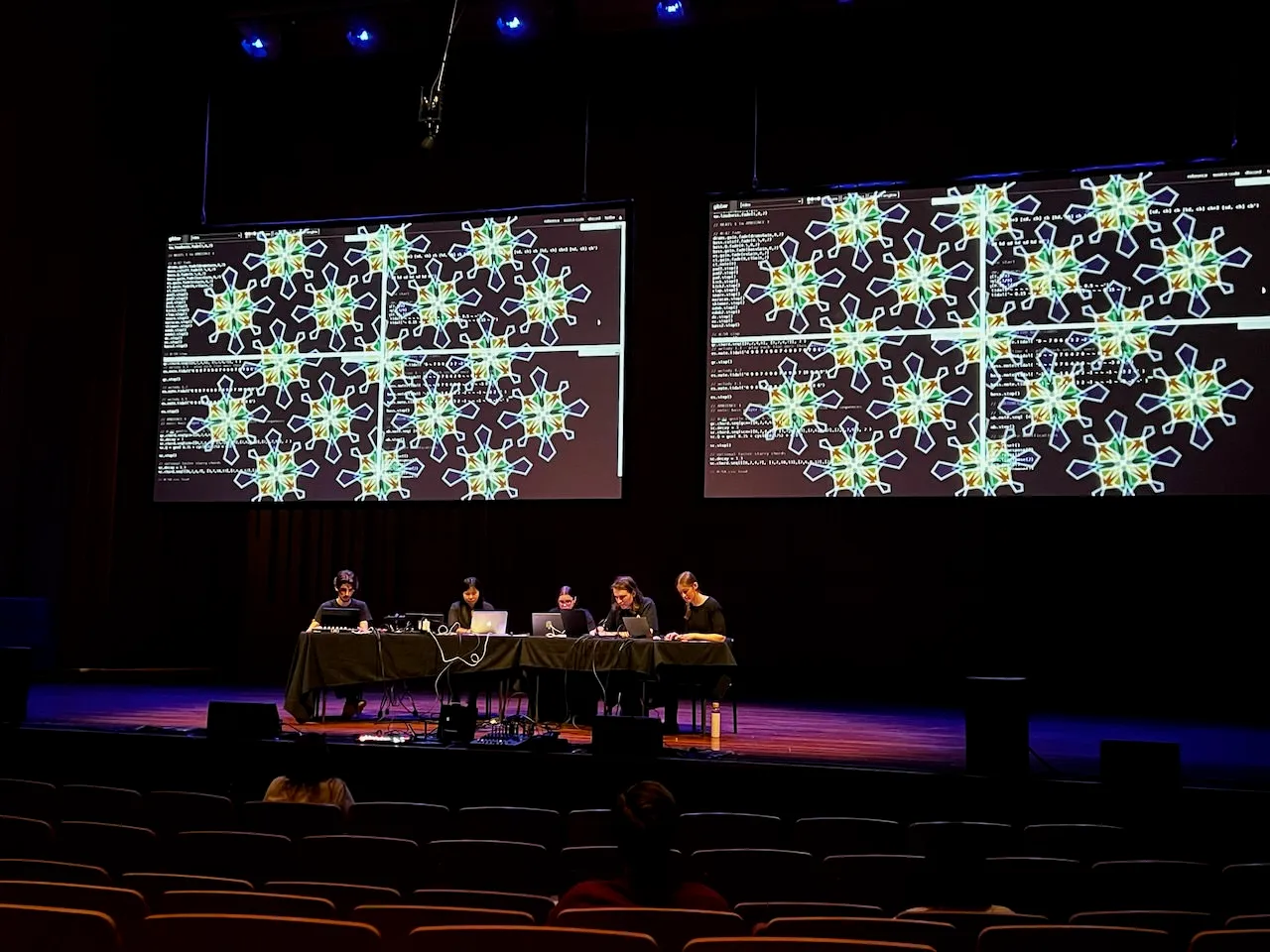
Course policies for COMP4350/8350 Sound and Music Computing, covering official class summaries, code of conduct, laptop requirements, and assessment rules.
This page extends and gives further context to information on the class summaries provided on Programs and Courses, and the ANU policies that cover all courses and student conduct.
Course Outlines#
The official course outline can be found on programs and courses.
Class Summaries#
The official class summary can be found on programs and courses. These official documents set out the content and assessment expectations for the course.
Code of conduct#
Everyone in this course is responsible for:
- Promoting an inclusive, collaborative learning environment.
- Taking action when others do not.
We reject behaviour that strays into harassment, no matter how mild. Harassment refers to offensive verbal or written comments in reference to gender, sexual orientation, disability, physical appearance, race, or religion; sexual images in public spaces; deliberate intimidation, stalking, following, harassing photography or recording, sustained disruption of class meetings, inappropriate physical contact, and unwelcome sexual attention.
It also includes coercion between students: pressuring, threatening, or claiming authority over another student.
If you think someone is violating these principles; for example, with a joke that could be read as sexist, racist, or exclusionary, we would like you to say something at the time, if you feel safe doing so. If you don’t, that is reasonable, and other pathways are open below as well.
All students are bound by the ANU Student Code of Conduct. Conduct that breaches that Code may be misconduct under the ANU Discipline Rule 2021.
If something goes wrong#
Talking to us. For anything about this course, its staff, your group, or how you have been treated, contact your tutor or the course convenor. Write down what happened as soon as you can (dates, times, who was there, what was said, what happened).
We will take it seriously, and we will not decide who is right on the basis of one account. Anyone a concern is raised about will get a fair chance to respond. We will handle what you tell us carefully and share it only with those who need it. We cannot always promise anonymity as it may be obvious in some classes who raised something, and some information has to be shared for a matter to be dealt with fairly. We will tell you what we intend to do before we do it.
Raising a concern in good faith is a legitimate use of this course’s processes. You should not feel pressured to raise a complaint or threatened if you have raised one.
If the concern is about course staff, or we haven’t resolved it, contact the Associate Director (Education), School of Computing: adir.education.comp@anu.edu.au
You do not have to come to us at all. The pathways below are independent of this course, and you don’t need our agreement to use them:
| Pathway | Where to go |
|---|---|
| Support and advice | ANU Student Safety and Wellbeing — student.wellbeing@anu.edu.au, (02) 6125 2211. Safety planning, referrals, and help working out your options. |
| Dean of Students — confidential, impartial advice, including on University policy. | |
| ANUSA — free, independent advice and support in navigating University processes. | |
| Disclosure | The ANU Harmful Behaviours Disclosure form is not a formal report or complaint. It connects you with a case manager, who will be in touch within 72 hours. You can lodge it identified or de-identified, and it does not stop you reporting later. |
| Formal report | A formal report of student misconduct is made under the ANU Discipline Rule to the Registrar, at reports@anu.edu.au. The decision whether to inquire is made by the Registrar or their delegate, not by this course or the School. Outcomes range from a reprimand to exclusion. There is no time limit on making a report. |
| Emergency | 000. On campus, ANU Security: (02) 6125 2249 |
The code of conduct above was adapted from the COMP1110 Code of Conduct, originally developed by Evan Peck of Bucknell University, with portions adapted from Dr Lorena A. Barba.
Attendance#
This course is designed for in-person delivery only due to the interactive nature of lectures and collaborative workshops. Remote participation is not supported in this course. Students are expected to have full attendence at all learning activities (lectures, workshops, concerts).
If you have any reason that you cannot attend a certain activity, you must communicate this with your tutor well in advance. If you cannot attend campus due to illness but are able to work from home, you may be able to have limited participation in workshops and collaborate with your group using the course forum.
If you have accessibility issues that impact your attendance or ability to access the learning activities, you must discuss this with the course convenor at the start of the course or as soon as these issues are known.
Communication#
Any communication in this course will happen over one of two channels:
- your student email account
- the course forum (you will be added to this in this in the week 1 lecture)
If you need to ask a question about the course, here’s how to do it:
- Ask on the forum, and any of the course staff or students will be able to help you.
- Use public posts, not direct messages. If you need to get a particular person’s attention,
@them in the main chat. - If you need help with a software problem, any assessment item, or just want to vent about writing loops in Pd, post on the forum
- Extensions are handled through a special website, see below.
- If you need to get in touch with the course convenor directly to discuss a private matter (and it really is private): firstname.lastname@anu.edu.au
- Disrespectful, harassing, or discriminatory posting or messaging this course is not acceptable and will not be tolerated (see the code of conduct).
Please not that the course staff are not likely to respond to messages or emails outside of ANU working hours or if they are on leave. Posting on the forum is the best way to get an answer from any available staff member.
Late Submissions#
Late submissions for assessment tasks are not accepted without an extension.
Extensions#
Link to the Assessment Adjustment FormIf you have any issues that would prevent you handing in work on time, please use the Assessment Adjustment Form.
- In most cases it is easy to arrange a short extension.
The Assessment Adjustment Form has built in instructions to help you provide correct information. You will be asked to include your student number (UID), a short statement of your situation and when you think you can get the work completed.
In the first instance, you do not need to provide documentation (e.g., a medical certificate or educational access plan), as this is not required for a short extension, but we may ask for it in some instances.
Note that:
- If you receive an extension you may not receive feedback on your work at the same time as other students.
- We do not process extensions every day, but will attend to your request within a few days. Do not send multiple messages.
- Extensions of more than two weeks are not generally granted except in exceptional circumstances.
Word limits#
Max word count limits are provided for the written assessment tasks in this course and we expect you to stay within those limits. You won’t lose marks until you exceed a word limit by more than 10%
Extenuating Circumstances Application#
If you have any unexpected and unavoidable issues that has affected your performance in the course (e.g., sickness, hardship or essential duties during assessment tasks), please think about applying for adjustment due to extenuating circumstances (link) to document your issue.
- The Assessment Adjustment form can help you figure out whether to apply for an extension or extenuating circumstances. For short extensions on non-exams, it’s almost always better to apply for an extension.
If you have a serious, unexpected, and unavoidable issue on the day of an exam which means you can’t do the exam on that day, please apply for Extenuating Circumstances (link).
Appeals#
From the date that your marks for any assessment item are released electronically you have a period of 10 working days in which to make an informal appeal of your mark to the course convenor.
An informal appeal requires some explanation about why the original mark was not correct (e.g., the marker accidentally missed a particular aspect of your assignment).
You should submit an informal appeal in a private message to the course convenor by email. Please include your student number (UID), a short statement of why you think your mark was not correct referring to the marking criteria for the assignment.
If an informal appeal is denied by the course convenor, you may still make a formal appeal. This requires a convincing statement that your mark was incorrect given the stated marking criteria and assessment instructions. For the formal appeal procedure see the information here.
Supplementary assessment#
If you receive a PX grade you are eligible for supplementary assessment. The assessment item may be an assignment, a written exam, an oral exam, or another form of in-person assessment. To pass this assessment item, you must demonstrate a “good” attainment of the learning outcomes, generally equivalent to a mark of 60/100.
Academic integrity#
At the ANU we take academic integrity seriously. In Sound and Music Computing all the ANU academic integrity principles apply.
In particular:
All ideas, code and content that is not created by you must be referenced.
You are allowed to include material in your assignments from others where it fits with the specification, but you must not pretend that you created it. See the ANU’s academic integrity best practices for learners to understand more.
In this course we aim for a strong culture of collaborative learning on all assessment tasks, but you are assessed on your individual contribution. Referencing work that you have (legally) adapted from online sources or from a colleague is a basic act of respect in a network of peers.
As a basic measure, we expect everyone to have at least two references in each assessment showing that you are aware of how to work independently in a studio environment and acknowledge sources.
If you act against the principles of academic integrity in this course, it’s very likely you’ll get caught. At a minimum, this will delay your feedback for an assignment. It might delay your completion of the course (and your graduation), and could have very serious consequences for your enrolment at ANU in serious cases.
Laptop Policy#
This course requires making music on a laptop, and so you’ll need to have a laptop and install some software on it. You definitely need a laptop because the classrooms for this course do not have computers provided and you need to use your computer in every lecture and workshop.
If you have any trouble with getting the software installed & working on your machine then there will be many opportunities to fix problems (especially early in the course). However, it’s your responsibility to make sure that the software works and that these issues are sorted out.
Software/hardware issues happen in performances (ask Charles for stories). You are expected be organised enough so that your setup is working and reliable before any assessment task is due.