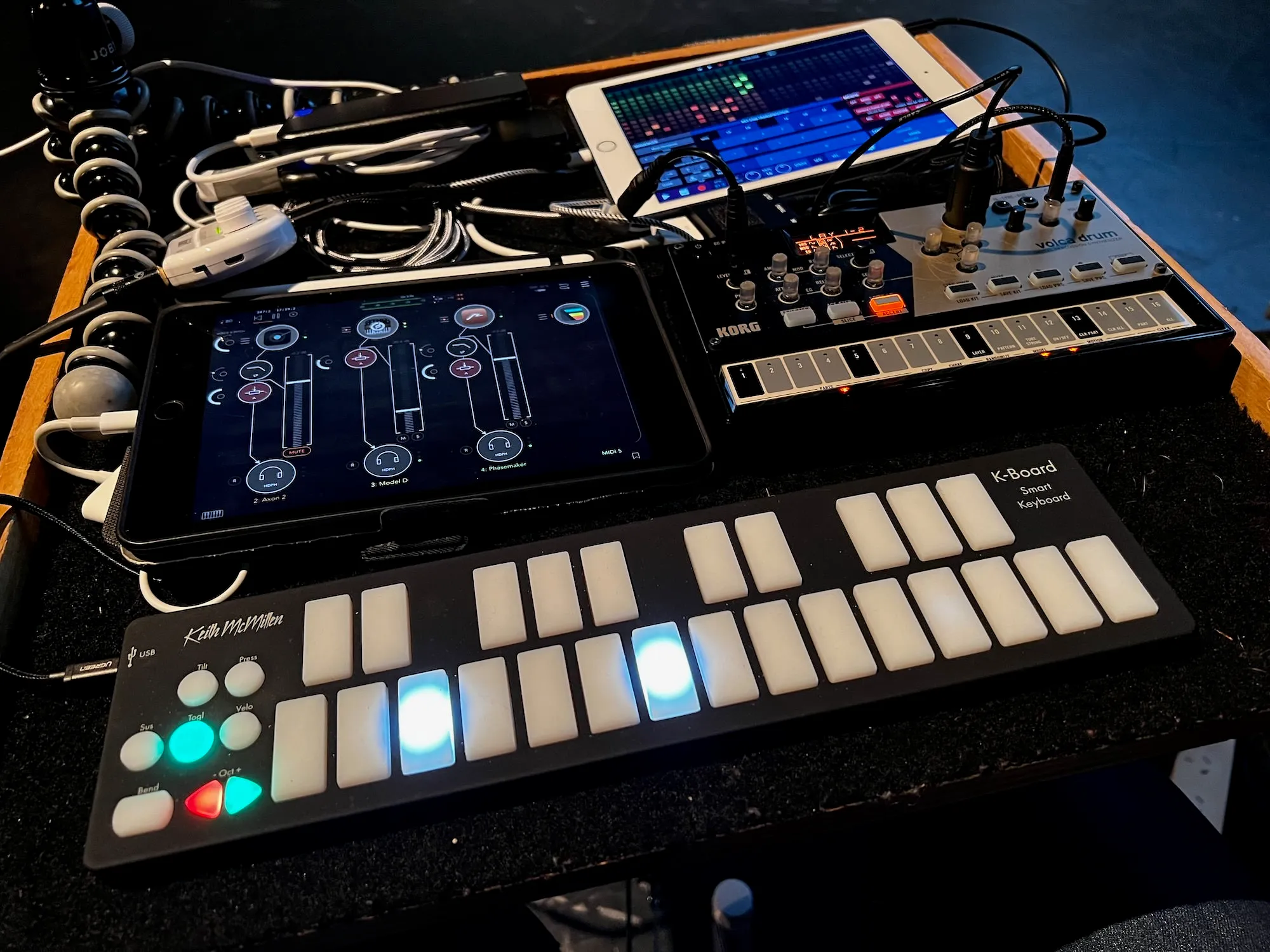
So what types of beeps and boops can we make, actually?
Synthesis is the process of generating musical signals “synthetically”, i.e. by some process other than hitting/plucking/rubbing a resonant body like a guitar string or a drum head. You’ve probably heard of people talk about synths (which are dedicated bits of hardware & software for making these musical signals) and synthpop (a genre of music from the 80s where these machines really started to take off in mainstream music), the stuff you’ll be doing here (in Pd) is based on the same basic ideas.
There are several different basic techniques for creating interesting signals1, and you can’t expect to master them all in one week (or even in one semester). So this week we’ll focus on just making noise with the basic sine tone oscillator from last week, looking at how we can apply a few basic mathematical transformations to the signal and hearing what those transformations sound like.
Goals for this week#
-
to learn what an oscillator sounds like
-
to learn the correspondence between different creative/musical goals (e.g. how to make something softer/louder, how to change the pitch of the sound) and the mathematical operations (addition, multiplication, chaining Pd outlets to inlets) which make them happen
-
to begin to understand how the different types of things in Pd (objects, numbers, messages) work together
Resources#
Here’s a video lecture about Pd to get you started with additive synthesis.
Here are some links:
- Charles’ slides about synthesis in Pd
- Charles’ examples from the video
- the Programming Electronic Music in Pd book (as mentioned on the tools page)
and a few more useful resources (not necessarily Pd-specific, and might be too )
-
Toby Rush’s Music Theory for Musicians and Normal People is a bunch of posters which you could print out and put on your wall (spans everything from the basics to intermediate/advanced stuff)
-
Lightnote’s How Music Works: Interactive Music Theory Lessons is, well, interactive (which is nice)
Creative Notes#
- what does “low” or “high” frequency mean in the context of synthesis? what’s the useful frequency range of an oscillator?
- are there any basic building blocks which aren’t “built in” to Pd? can you make them yourself?
- can you look at a given Pd patch and try and guess what it will sound like before you turn on the DSP? is being able to do that even important/useful?
Footnotes#
-
That Synthesizer wikipedia page has several links to these fundamental techniques in the opening paragraph. ↩