
Length: Honours and Master projects run over two semesters.
Short project: Also available as a six-week summer research scholarship or a one-semester COMP3740 project (see the short-project scope below).
Prerequisites: Web development in JavaScript (the server is in Python). An interest in improvisation or ensemble performance; you don’t need to be an expert musician.
About this project
This is a research project in the Sound, Music and Creative Computing Lab (SMCClab) at the ANU School of Computing, supervised by Charles Martin. The lab studies intelligent musical instruments: instruments with a built-in AI model that generates musical actions of its own, responding to the musician or playing alongside them. Most of our projects use IMPSY, the lab’s open-source system that records a musician’s gestures from a MIDI controller, trains a small neural network on that data, and then plays back and responds in live performance on a Raspberry Pi, laptop, iPad, or in a web browser. You don’t need to know these systems before you start: the background reading at the end of this page is the place to begin.
These projects build the physical and networked systems that the lab’s music research runs on. The lab provides the hardware (Raspberry Pis, iPads, MIDI controllers, and synthesisers), and the result is something musicians can use outside the lab.
This project
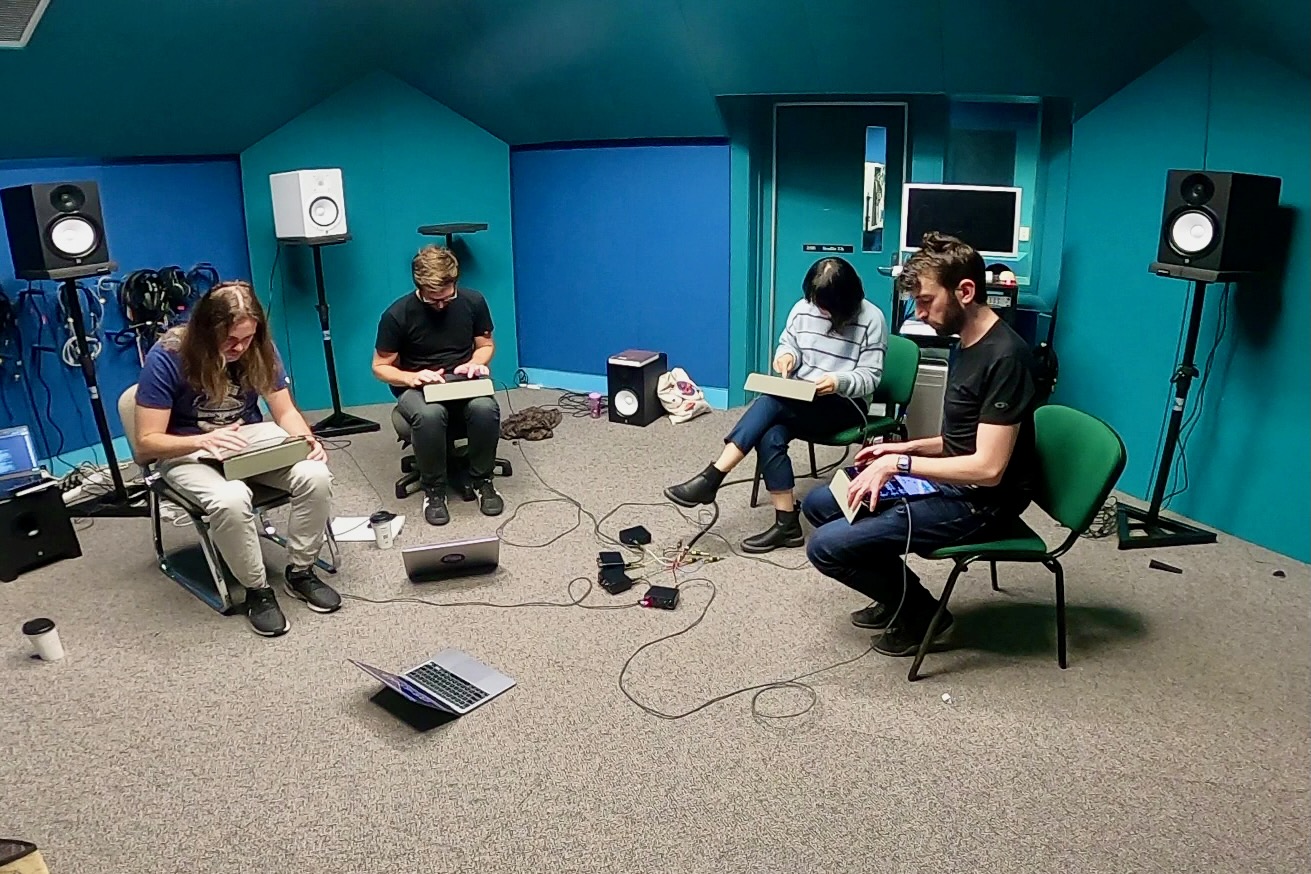
In our networked touchscreen ensemble, each performer plays a web-based synthesiser on an iPad, and a server links controls between their instruments. When one performer turns a knob, the change can also appear on someone else’s synth, possibly delayed or inverted. A composer writes a schedule of these interface connections, and the ensemble improvises within the changing set of links.
Our first sessions with this system found that the density of connections mattered more than which controls were linked. A single connection was rarely noticed, so we ended up copying rules until the composition file was 8000 lines long. The instrument also didn’t show performers which of their controls were connected. In this project you’ll take the next step: design a composition syntax built around connection density and types of connection, show performers what is connected to what, and test the new system in ensemble sessions.
- Short project: a compact composition syntax (e.g., “20 random connections, half of them delayed, for the next two minutes”) and on-screen highlighting of linked controls, tested in sessions with the lab ensemble.
- Full project: the same, plus a performance study with outside musicians comparing composition techniques (e.g., direct, delayed, and inverted connections), which needs ethics approval. Another option is a composer agent that adjusts connections in response to what the ensemble is doing.
Background reading
- Martin, C. P., Hunter, A., Schuetze, B. and Wang, Y. (2023). Composing Interface Connections for a Networked Touchscreen Ensemble. IEEE International Symposium on the Internet of Sounds (IS² 2023). Preprint.
- Martin, C., Gardner, H., Swift, B. and Martin, M. (2016). Intelligent Agents and Networked Buttons Improve Free-Improvised Ensemble Music-Making on Touch-Screens. CHI 2016.
- Weinberg, G. (2005). Interconnected Musical Networks: Toward a Theoretical Framework. Computer Music Journal.
More projects in the lab
This is one of more than a dozen projects currently available in the SMCClab, covering machine learning, embedded hardware, HCI, visualisation, theory, and artistic research. Only a selection is listed on the School of Computing website, so see the full list of SMCClab student projects on the lab website. You can also read this project on the lab website.
How to Apply
To apply for this project, contact Charles Martin.
Include:
- your CV
- your unofficial transcript (if you are an ANU student)
- a brief statement (200 words) in your email explaining how you would approach this project
Make sure to specify the skills and accomplishments you have that would help you to complete this project. Please read about joining the SMCClab and our project expectations before applying.